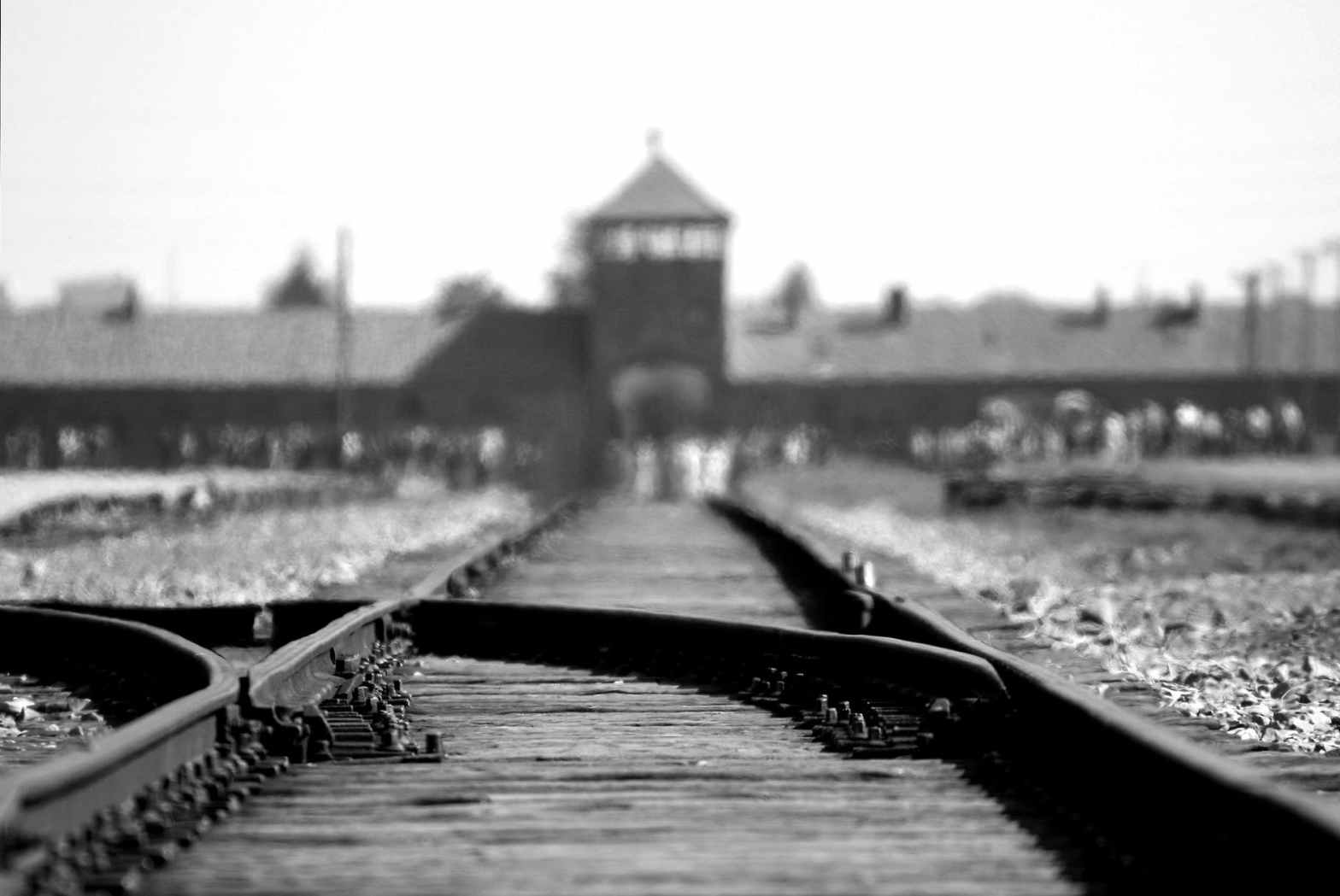
Auschwitz. This word pierces my soul and causes my blood to run cold like few other words can. Nobody who understands what it means can hear the word without it affecting them deeply. For anyone who does not know, Auschwitz is the site of the greatest mass murder to occur in human history. It happened not long ago, and not far away.
“Auschwitz. Not long ago. Not far away.” is the name of the exhibition going on now through January at Union Station in Kansas City. Even as I approached the building and saw the distinctive train car (representative of the ones used to transport millions of people to their death) my heart began to ache. Inside the exhibit, I was greeted by a solitary red shoe – one of the countless shoes found piled at the camp when it was finally liberated in the closing days of World War II. I walked past concrete posts with strands of barbed wire. Through audio, video, and written narratives, I learned even more about the atrocities committed against my fellow humans – atrocities committed by my fellow humans. I saw one of the beds that history books show filled with emaciated prisoners who look more dead than alive. I touched the cold, rough wood of one of the barracks walls, viewed the layout of the massive camp, and learned the stories of individuals and entire communities that were destroyed. I saw the frightened and confused faces of the victims, I witnessed actual murders caught on film, and I heard the voices of survivors. I saw a re-creation of the gas chamber door, and I saw an oven door and ash pan that weren’t re-creations. I watched home movies, recorded before the war, showing families whose lives were taken a few years later. I saw, heard, and read so many things that my eyes are filled with tears as I type these words several weeks after my visit to the exhibition.
Most importantly, I learned. I learned just how powerful and destructive hatred can be. I learned how quickly a dynamic leader and a manipulated press can corrupt an entire population. It became clear that a government can institute its own agenda by changing the wording of the textbooks and controlling what is taught in schools, and in one generation it will change the course of human history. I saw how a nation can be taught to hate those the government hates, simply by constantly exposing the people to language and “news” that matches the agenda of leadership. I learned what happens when members of certain groups are labeled as problems, not people. I realized how these same tactics are still in use today, and that we must resist the teachings of hatred that are so rampant in our society right now. I learned just how destructive a combination of hate, fear, willful ignorance, and refusal to speak up can be.
Oddly enough, this exhibit also showed me the power of love. Survivors talked about how one act of kindness gave them the strength to go on. One survivor had someone he didn’t know literally choose to be starved to death in his place. Another talked about someone giving up their blanket for her. One lady managed to hide her engagement ring from her captors, and the love represented by that ring took her through the darkest of times. Love prompted some neighbors to help people hide or escape. The powerful message of one survivor explained how everyone who survived Auschwitz had made a friend or personal connection with someone else. She said the ones who would try to ease another’s suffering by sharing a morsel of food or a kind word were able to carry on, while those who thought only of themselves did not survive. But the most powerful expression of love came in the message repeated by so many survivors. They said not to hate those who committed these heinous acts, for hatred destroys. They chose love over hatred, forgiveness over revenge, and unity rather than division. “Do not hate” was their message to the world after being liberated. That, they said, is the only way to prevent these atrocities from happening again. That is the only way to ensure the cry of “Never again, Auschwitz!” is heard.
Learning more about Auschwitz, the Holocaust, and the underlying message of hatred that allowed it to happen, has opened my eyes to the rampant hatred that I see being communicated on a daily basis. I’ve been aware of it but had not realized just how dangerous it truly is. Every time one particular group is singled out, that is a message of hate designed to cause division, which can then lead to attacks on anyone who is a part of that group. If you don’t think this is happening, then you are simply not paying attention. Any time the media chooses to report the nationality or race of the people involved in a crime, they are communicating hatred toward that particular nationality or race. The skin color of a murderer or the victim does not matter. A human killed another human, and that is what is important. Stating how the Republicans or the Democrats are destroying America is encouraging division, a weapon of hate, by implying that everyone who votes for that party is evil. Saying that immigrants are taking all the jobs is not only false, but it is promoting hatred of anyone who doesn’t look, speak or act like you. Calling out the religion or occupation of a child molester is indicating that anyone of that faith or occupation is a child molester. Time and space do not allow me to illustrate every method used to promote hatred, but it is prevalent in our daily lives. We must be aware of it, and we must refuse to be taught to hate. Otherwise, the next Auschwitz is just around the corner.
One powerful message that I took away came from the words of a German Pastor, Martin Niemoller:
“First they came for the socialists, and I did not speak out - because I was not a socialist. Then they came for the trade unionists, and I did not speak out - because I was not a trade unionist. Then they came for the Jews, and I did not speak out - because I was not a Jew. Then they came for me - and there was no one left to speak for me.”
These words ring in my ears and bring me shame, because of my own refusal to speak out on so many occasions. My voice may be small, and I may be but one person, but I still must speak out against hatred. I have a voice, and I must use it – in my family, in my church, in my community, in my workplace, in the voting booth, in my daily interactions with people. I can speak in love, and not hate. I can speak for those who cannot speak for themselves, or for those whose voice is being ignored. My voice can join with countless others to bring down the destructive forces at work in our world. My voice can make a difference. My voice may be exactly what someone needs to hear to help them go on, showing them that they are not alone. My voice can prevent a suicide, stop a crime, calm the storm in somebody’s life, or drown out the sound of hate. My voice can teach love. It can inspire a young person to choose a better path. My voice can change the world – but only if I use it. By refusing to hate and speaking in love, I will make a difference. I will be echoing the vital message: “Never again, Auschwitz!”
 FYR Presentations